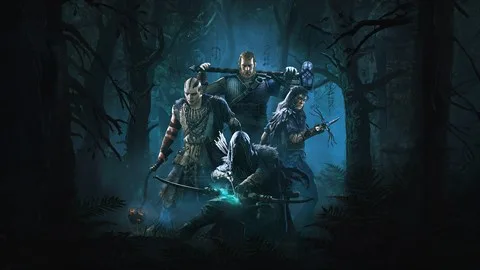
During an activity for a Game Artificial Intelligence course, I analyzed an interesting case from Hood: Outlaws & Legends: the way the game tries to predict when and where to intercept players who are moving away from the intended stealth experience of the match.
The game is a PvPvE experience where two teams of four players try to steal a treasure protected by an elite NPC, the Sheriff, and by guards known as The State.
The match structure involves stealing a key, locating the treasure, carrying it, and trying to extract it. However, because the game has a strong stealth premise, players are not supposed to simply run across the map while ignoring the stealth systems.
That is the interesting point: the game needed to react when players started breaking the intended experience.
The design problem
According to the developers, some players were ignoring part of the stealth design of the game. Instead of using stealth, they ran across the map, alerted guards, and reduced the importance of the systems created to generate tension.
This created a design problem.
If the game allows players to ignore stealth without meaningful consequences, then the stealth systems lose weight. The experience stops being about infiltration, risk, and tension, and becomes only a race toward the objective.
To respond to this, the team created a system capable of observing player behavior in real time and adapting the NPC response.
The idea was not simply to prevent the player from playing differently, but to create consequences for very exposed actions and encourage a stealthier approach.
What is being modeled
In this case, the system is mainly modeling player behavior.
It observes concrete actions during the match, such as:
- player position;
- movement speed;
- likely route;
- key state;
- treasure state;
- NPC perception;
- proximity to important objectives.
But the final goal is not only to understand behavior.
The goal is to adapt the experience.
In other words, the game uses behavioral data to change how NPCs respond, increasing tension, risk, and pressure when players act in a way that is too exposed.
This difference matters.
The system does not seem to be trying to create a complex psychological profile of the player, like in Left 4 Dead. It does not need to know whether the player is “aggressive,” “cautious,” or “competitive” in a broad sense.
It needs to answer a more practical question:
Is the player moving in a way that threatens to break the stealth premise of the experience?
How NPCs react to the player
The analysis described in the chapter about Hood: Outlaws & Legends involves predicting when and where to intercept the player.
To do that, the system uses data from the current match state.
One first set of data helps predict the player’s possible objective:
- where the player is;
- where the Sheriff is;
- where the key is;
- where the treasure is;
- whether the treasure is still in a room;
- whether it is being carried;
- whether it is being extracted.
With this information, the AI can estimate a likely path between the player’s current position and their possible objective.
According to the book, this likely path was calculated through pathfinding over a simplified NavMesh without doors. This means the system does not need to predict every possible player movement. It only needs a good estimate of which route makes sense in that context.
When the AI should react
After estimating the objective and the likely path, the system needs to decide when to react.
An overly aggressive response could feel unfair. If the AI punishes any movement, even when the player is playing correctly, the experience becomes frustrating.
Because of that, the decision involves a few checks.
Movement speed
Players moving quickly can be considered potential targets for AI intervention.
This makes sense within the game’s premise, because running across the map can indicate that the player is ignoring stealth and trying to advance too directly.
Player route
Another check compares the player’s movement direction with the likely path toward the objective.
If the player’s velocity vector is aligned with the likely path within an acceptable margin, the system can assume that they are moving toward the predicted objective.
This helps the AI differentiate between a player who is only repositioning and a player who is actually trying to advance directly toward the objective.
NPC perception
The last check is essential: NPCs need to perceive the player.
This avoids unfair consequences. If the player is moving quickly but has not been perceived by any guard, it does not make sense for the game to react as if they had broken stealth.
For the AI to react, a guard or the Sheriff must have full perception of the player.
This seems like a good design decision to me, because it connects player modeling to the game’s own perception system.
The AI intervention does not happen only because the system “knows” where the player is. It happens because, within the fiction of the game, the NPCs also perceived that action.
Where the AI should react
After deciding that it needs to act, the AI needs to decide where to intercept the player.
To do this, the game uses strategic points defined in the map. These points work as possible locations for setting up a barricade and positioning guards to redirect the player toward the intended route.
The AI evaluates the likely path, decides possible barricade locations, and calculates which guards can reach those interception points in time.
From there, it chooses barricades and sends guards who can arrive before the player.
The goal is not only to chase the player directly. It is to create a tactical response that anticipates their likely movement.
If the player keeps moving toward the predicted objective, the barricade serves its purpose. If they return to the expected behavior, the system can dismantle the barricade after a while.
This creates dynamic match adaptation without necessarily requiring a complex learning system.
Why this is player modeling
Within the taxonomy of player modeling, this system fits mainly into three roles.
Behavior analysis
The system observes player actions in real time, such as position, speed, likely route, objective state, and NPC perception.
These data points are used to interpret what the player is probably trying to do.
Behavior adaptation
After the analysis, the AI adapts NPC behavior.
Guards can change their response, reposition, try to intercept players, or form barricades at strategic points.
It is important to notice that the behavior being directly adapted is the NPC behavior, not the player’s.
The player is influenced by the system’s response, but not controlled by it.
Experience adaptation
These changes alter the player experience in real time.
The match becomes more tense, risky, and pressured when players act in a very exposed way.
As a result, stealth remains a relevant strategy.
Summary
The system uses rules defined by the developers to interpret player actions and define AI responses.
There is real-time data involved, but this data does not seem to be used to create freely emergent behaviors or to cluster player styles.
The behavior is already categorized by design rules.
The system knows which signals matter, which situations should be considered risky, and which responses can be used.
In Hood: Outlaws & Legends, the interesting part is the use of clear rules to create an adaptive response.
The AI does not need to “discover” on its own what it means to break the stealth premise. The designers already defined the signals and the consequences.
What I learned from this case
The most interesting point for me is that player modeling does not need to be extremely complex to be useful.
Sometimes the game does not need to deeply understand the player.
It needs to observe enough signals to respond better to the situation.
In this case, data such as position, speed, likely route, and NPC perception already allow the game to create a relevant adaptation of the experience.
I also found it interesting how the system connects AI, level design, and game design.
Interception points depend on the map. The decision to react depends on NPC perception. The consequence exists to preserve the tension of the stealth experience.
In other words, the AI is not isolated.
It works as part of a larger design system.
Conclusion
The analysis of Hood: Outlaws & Legends shows that player modeling can be used to preserve an intended experience.
The system observes player behaviors, estimates likely intentions, and adapts the NPC response to create tension and consequence.
For me, the main lesson is:
Modeling the player does not mean understanding everything about them. Sometimes it is enough to observe useful signals and adapt the game’s response.
This type of system shows how AI in games is not only about “smart” NPCs. Often, it is about creating responses that support the experience the design wants to deliver.
References
- Game AI Uncovered: Volume One, Chapter 3, “Predicting When and Where to Intercept Players in Hood: Outlaws & Legends”.
- Xbox Wire, “Designing the Felony System and Stealth Mechanics in Hood: Outlaws & Legends”.