No cover available Game AI Uncovered: Volume One
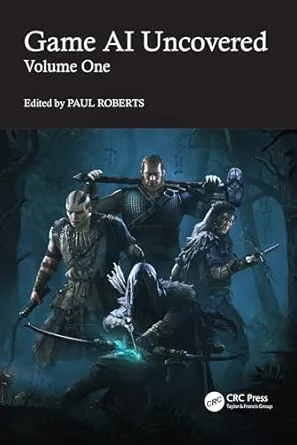
The book brings together the experience and knowledge of 20 industry professionals and researchers to present different solutions developed using artificial intelligence in games.
Technical books, game design references, and materials that influence my growth as a game developer.
No cover available The book brings together the experience and knowledge of 20 industry professionals and researchers to present different solutions developed using artificial intelligence in games.
The book brings together the experience and knowledge of 20 industry professionals and researchers to present different solutions developed with artificial intelligence in games. Rather than teaching one specific technique, each chapter examines a problem encountered during the production of a different commercial game.
The examples show that developing AI is not only about creating intelligent enemies. It is also about finding solutions that suit the genre, mechanics, and even the technical limitations of each project.
The main lesson seems to be that there are no universally correct answers to the many problems found in game development. An effective solution depends on the behavior the player needs to perceive, the number of agents involved, and the available resources.
In many cases, AI that is predictable, readable, and consistent with the game's design can be more valuable than an extremely advanced system. The book works as a collection of case studies that presents new possibilities and shows how experienced developers selected appropriate tools to solve problems in their projects.
No cover available The book presents several programming patterns, using practical examples to show possible solutions to common problems in game development.
The book presents several programming patterns through practical examples that demonstrate possible solutions to common game development problems. Throughout the book, the author tries to balance three conflicts programmers will face in their careers: developing quickly, keeping code readable, and preserving performance.
Although it demonstrates many techniques, the main lesson does not seem to be simply learning and applying every concept. Good architecture does not necessarily mean producing extremely complex, generic, or abstract code. It means building a structure that lets the team continue developing without losing control of the project. This is especially valuable because it is easy to discover new concepts and try to apply them everywhere. In one of my university projects, made with Godot for a game jam, I tried to build a hierarchy with components. It created unnecessary complexity, slowed down the project, and made collaboration with the rest of the team harder.
Patterns should be used to solve real problems encountered during development, not simply because they look elegant or technically sophisticated. In the end, finishing the project remains more important than pursuing a theoretically perfect architecture.
No cover available My current read. I’m diving deeper into multiplayer systems.
More details coming soon.
No cover available The book offers a reflection on the meaning of fun and the reasons why people play games.
The book reflects on the meaning of fun and on the reasons people play games. Rather than presenting techniques or rules for creating games, Raph Koster examines how the brain recognizes patterns, learns systems, and develops mastery over specific challenges. According to the author, much of the fun comes from this process of learning, understanding, and improving.
The author also discusses how different people find fun in different experiences and how games are not defined only by stories, graphics, or technology. These elements can improve presentation, but systems, choices, and the patterns players interact with sustain the experience. The book also expands the discussion to the cultural role of games, their ability to communicate ideas, and the responsibility of those who design these experiences.
My main lesson was that creating fun does not simply mean adding rewards or keeping players occupied. It requires offering something they can discover, understand, and master. The book is a reflection on the essence of games and shows that game design is not only about producing interesting rules, but about organizing learning experiences that keep players curious and engaged.
No cover available The book presents different development patterns applied directly to Unreal Engine 5, showing how they can help create systems that are more readable, modular, and easier to maintain.
The book presents different development patterns applied directly to Unreal Engine 5, showing how they can help create systems that are more readable, modular, and easier to maintain. Besides explaining well-known patterns, the authors examine how many of these ideas are already part of the engine's architecture and tools.
Throughout the book, the reader learns to identify patterns in features such as components, Behavior Trees, and update methods, as well as to build less tightly coupled communication systems with interfaces and events. It also discusses the relationship between C++ and Blueprints, arguing that both tools can be combined according to the performance, flexibility, and maintenance needs of each system.
The main lesson seems to be that using patterns in Unreal first requires understanding the solutions the engine already provides. From there, developers can decide where they can genuinely improve the organization or performance of a project.